cairn


Cave Point, Door Co., WI – Version 2


“Jesus responded, “Listen to me.  If my followers were silenced, the very stones would break forth with praises.” Luke 19:40 (TPT)

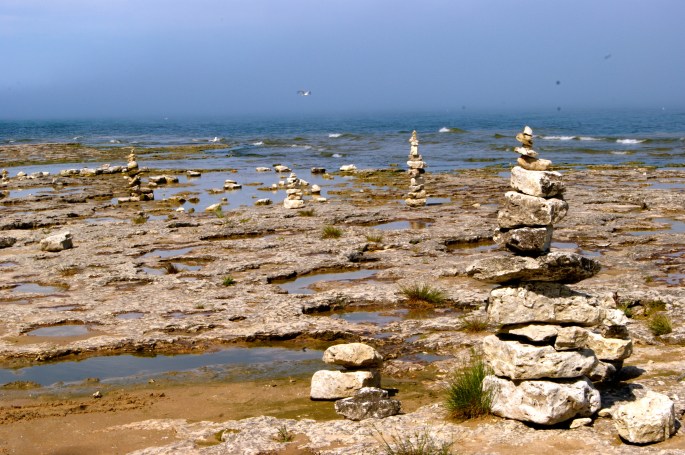
As I approach the shoreline, I’m surprised to find something unexpected waiting for me.  The shoreline is simple, rocky and rugged, filled with small tidal pools (the water level is high).  The sky is a foggy blue and hosting a few gulls in flight.  I’m familiar with this scene, which is quiet and peaceful apart from the sound of waves upon the rocks and the gull’s occasional cries.  It’s a solitary scene – there’s not another human being in sight.  However, there is evidence of human presence all around me in the form of cairns – stone towers of varying shapes, sizes and heights; too many for me to count.  As I study some of the towers more closely, I’m amazed by their height and ability to remain standing.  Some stones are large and flat, good for stacking.  Some of the stones are small, unusually shaped and precariously placed.  These towers boggle my mind; the balancing act that keeps them upright defies my comprehension.  I’m in awe of their ability to stand at all, let alone through the movement of the waves.  As I ponder this marvel, Luke 19:40 pops into my mind.  I smile as I consider these stones; they have life and purpose, too, and I’m compelled to listen to their story.  They have something to teach me about God, and they offer me a sense of comfort and awe in the presence of this mystery.  They share a lesson in how God’s building techniques differ from those of mankind.  They also proclaim to me that I’m not alone on this earth – God’s creation is all around me at all times, being and living to enjoy their Creator.  I feel God’s loving presence in each cairn, wave and gull, and I’m thankful for the message of wonder and praise that they give.

As I quietly listen, I hear God say:

“My beloved child, everything that I build is built with wonder and mystery.  Many will look on and scoff at the simplicity of style, the unlikeliness of the materials that I choose and the ordinariness of the location itself.  Mankind looks for polish and finesse, things to puff the ego and impress.  I don’t build to puff or impress.  My building plan goes much deeper.  I build to bewilder the certain and delight the confused.  You will never be able to explain or understand how I build: in nature, in life, in love, in work and service, in relationships, in communities, in the hearts and souls of mankind, in anything.  But if you pay attention, you will know when I am the builder and when I am not.  My creations will always perplex, amaze, and mystify.  Keep your heart open and your mind free of concern; let my creations delight you.  Be available to be transparent and vulnerable as I call you to be.  Receive the redemption and transformation that I am building within you and through you.  Marvel at what my methods produce both in you and in others around you.  Entrust yourself to my mysterious methods and ways; they are tried and true.  Lean into my presence and follow me.”


earn

“And when those who had been hired first came to be paid, they were convinced that they would receive more.” Matthew 20:10 (TPT)

“Why should my generosity make you jealous of them?” Matthew 20:15 (TPT)

Jesus describes the kingdom of God with a story about a landowner who hires people to work in his field. He hires many people as he comes across them throughout the day: at daybreak, at 9:00am, at noon, at 3:00pm and at 5:00pm. He agrees to pay the accepted daily wage with each person he employs. When evening comes, the workers line up (from the last hired to the first hired) to receive their pay. When the workers hired at daybreak see those hired at 5:00pm receiving the full “daily wage” amount, they assume and expect that they will receive much more pay. When they are also given the agreed upon daily wage amount, the same amount received by those who only worked one hour compared to the entire day that they worked, they become offended and angry. They complain to the landowner, calling his treatment of them unfair. The landowner denies any unfairness and reminds them that they received the amount that they agreed to. He also states that he has a right to spend his money as he sees fit, and he sees no reason why his generosity would justify their jealousy of others.

I can understand and appreciate the conflict described in this story. The workers are coming from the perspective and goal of earning money. The landowner is coming from the perspective and goal of extending grace and mercy while simultaneously getting his grapes harvested. The landowner is not just thinking of his own personal gain (completing the harvest); he’s also thinking about his community—providing jobs and income for all the people that he can, and being generous in the process. The earliest workers appear to have no complaints until they compare themselves with those who are hired last—turning their focus towards getting what they think they deserve in comparison to what they believe others have earned. Their code of justice is offended, and they resent being viewed in the same light as others that they believe to be less deserving. I admit that I understand their anger. In the world system, which is based upon earning what you get, their experience is completely unfair—it is, in fact, downright un-American! But the landowner, who represents God, has a different system with a whole different view of justice—it cannot be “earned”, it can only be received. God’s justice is based on grace, mercy and love, not what you’ve done (earned) or not done. Therein lies the rub: world system vs. heaven system. I’m happy and grateful to be a recipient of God’s grace, mercy and love. But am I equally happy and grateful to observe others, who I believe to be less deserving, receive God’s grace, mercy and love as well? Am I humble enough to view myself as being in the same “undeserving boat” with others, especially those who I view as being thoroughly inhumane—unloving, uncaring and un-repentant? How difficult is it for me to relinquish the codes of the world system for the alarming and bewildering codes of grace of heaven’s system? How willing am I to relinquish my assumptions and expectations regarding what I think I (and others) deserve? How readily do I accept and receive God’s merciful ways regarding myself, and others? All good questions, indeed!

The “great reversal” of the first being last and the last being first in the kingdom of God is confusing, for sure! From an earthly, worldly perspective it makes no sense, it can’t be figured out and it even seems quite unjust.  Is that because the world is in the realm of the mind, whereas, heaven is in the realm of the heart? Who can mentally grasp, let alone comprehend, the love, mercy and grace of God? Not me!

As I ponder this, I hear Jesus say to me:

“Dear child, don’t try to figure out my love—just receive it! Let go of the worldly codes that you were raised on and have worked so hard to observe; they will never satisfy the needs and longings of your heart and soul, they will only disappoint and exhaust you. Come to me and embrace my love, mercy and grace—both for yourself and for the world around you. There is NOTHING on this earth that I do not love—I love every person, animal, vegetable, mineral, land, sky, ocean, etc. I love it ALL! Embrace my love and allow my love to embrace you—only then can you be fully human, only then can you live life as it was intended to be lived. I want this for you because I love you and I want you to be with me always—each moment of each day.”

Thank you, Jesus! So be it! Amen!

shade

20180901_131732

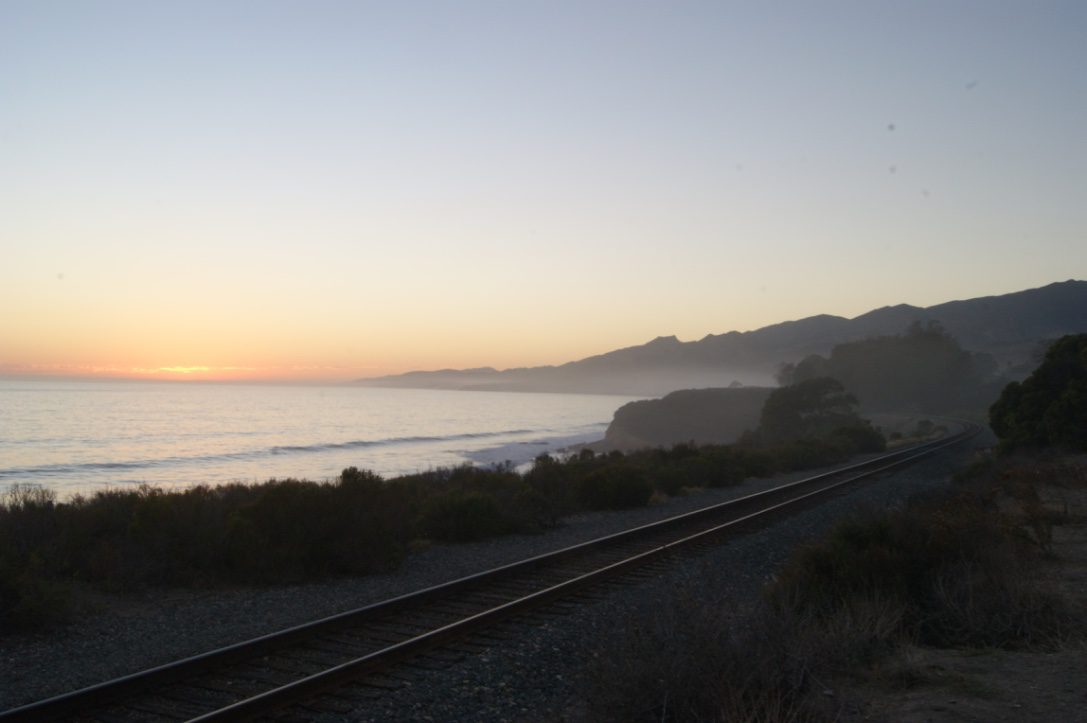
This photo evokes opposite emotions within me. Viewing the rugged, sunny coastline, the rich blue ocean and the pale blue sky fills my heart with a sense of adventure and longing—longing for the sunny vision that’s nearby, just waiting for me to join it. The trees in the foreground that I view the coastline through are almost black in appearance—deeply in shadows compared to the brightly lit coastline. This makes me feel like I’m in the dark, watching from the shadows. That sounds ominous, but it doesn’t feel that way. Oddly enough, I feel content to stand in this shade—it’s cool and quiet here, protected from the wind off the ocean and the bright glare of the sun. This is not the “dead dark of night” that I feel. This shade is a place of rest, where I can catch my breath. It gives me a feeling of safety and peace. The adventure of this coastline is one that I’ve experienced before, and I have a sense that I’ll be returning to it soon enough. Just for now, though, I’m grateful for a moment in the shade, away from the hectic wind and the glaring light—a time to be still and at peace. As I stand here, I notice that the view is spectacular, especially when framed by the still, quiet shade.

As I sit with this photo and ponder the nature and tempo of my own life at present, I hear God speak to me:

“Come into the shade and rest with me. Let the adventure of each day be perfectly framed by my quiet, still and peaceful presence. The adventure will be exhausting, draining, if you don’t take time to breath with me. Don’t worry about missing anything; the adventure will still be there when you leave the shade. Come away, and be with me.”

cat

“For against its will the universe itself has had to endure the empty futility resulting from the consequences of human sin. But now, with eager expectation, all creation longs for freedom from its slavery to decay and to experience with us the wonderful freedom coming to God’s children.” Romans 8:20, 21 (TPT)

I recently attended a one-day retreat at a local monastery, and I decided to arrive one day early so I could bask in some quiet solitude before the retreat began. I had been reading through the book titled Discernment by Henri Nouwen, and I took the book with me for more reading and reflection. As I pondered chapter 4, entitled Read the Book of Nature, I began to perceive Romans 8:20, 21 in a new way. I had understood that all of creation is “groaning” as it waits for Christ’s return and the renewal of all things, but I had never really considered nature’s experience of this. I read this verse in several Bible translations and I was struck by how The Passion Translation expressed its meaning. Phrases like “against its will” and “consequences” and “slavery” grabbed my attention and imagination. I know from my own life experience that it’s hard enough to suffer consequences as a result of your own poor choices, but to suffer the consequences of others’ poor choices really sucks big time—and this is what all of creation has been experiencing throughout time: consequences resulting from the choices of others. I have always loved and enjoyed nature, but this epiphany led me to a new and deeper empathy for nature.

I suddenly had a desire to walk among the grove of trees on the monastery grounds so I went outside for a stroll. As I walked through the trees, I began to wonder which ones where my age and which ones were older than I. I came to one tree whose trunk was too immense for me to reach around, and I knew that this tree was certainly my elder. I took a very good, long look at this tree. Winter had removed all of its leaves and I was able to notice its shape, places of scars and brokenness as well as the smaller branches of the previous summer’s growth. I saw the tree as a being, not a thing, and my heart broke. I found myself apologizing, out loud, to the tree for the consequences that it has experienced as a result of my choices and those of the rest of humankind. I asked for the tree’s forgiveness. As I stood with the tree, I felt a sense of inner peace, and I took that to mean that I had been forgiven. I felt very thankful for the solemn and sacred moment that we had shared.

I walked on through more of the trees, sitting under a few as I soaked up the thin warmth of the winter sun. I felt an amiable companionship between us all. As I walked back toward the building where I was staying, I passed an old building where the sisters make pottery. The door to the building had a small “cat door” in the bottom and I noticed a cat sitting just outside the door, soaking up the warmth of the late afternoon sun. At first she didn’t seem to notice my presence, but then her eyes opened. She looked directly at me, a look of stereotypical feline aloofness. I smiled and nodded in return. We gazed at each other for a few moments and then I spoke to her, out loud, as I had to the tree. I apologized for disturbing her peaceful enjoyment of the sun. She just looked at me, expressing nothing, as cats often do. Then I asked for her forgiveness, as I had done with the tree. For a moment or two, she continued to just look at me. Then she closed her eyes and slowly nodded her head up and down three times. She opened her eyes, gazing at me as she had done before, and then she turned and disappeared through the cat door into the pottery building. I was dumbfounded and amazed, but I felt no doubt that she also had forgiven me . . . just like the tree. I have no idea what the cat’s name is, but I have chosen to remember her as Grace. I felt humbled by the kindness of the tree and the cat, and the generous hospitality of all of nature to share its home with me. I have never felt more one with all of creation than at that moment! I intend to continue to ask nature, and all of creation, for forgiveness. To do so is the way of reconciliation and peace.

autumn


Atchison, KS – Version 2

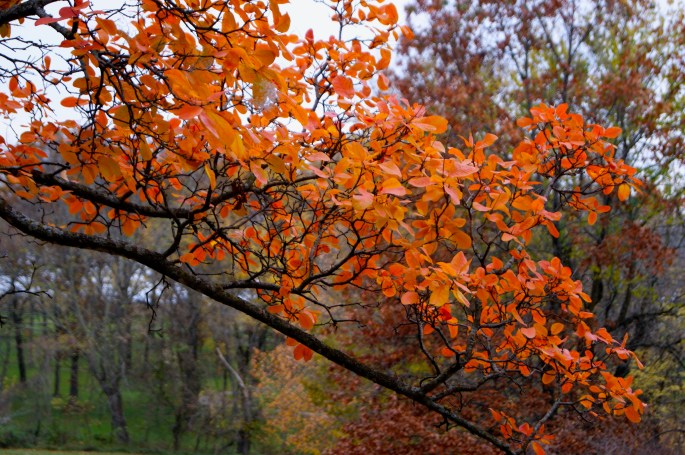
My first sight of this photo makes me feel happy and alive. Autumn is here! My birthday, fabulous leaf colors, sunny yet cool days, crisp nights and mornings—all join together to make autumn my favorite season. Though autumn always signifies the end of summer (fruitfulness) and the approach of winter (dormant hibernation), autumn always seems to be brimming with life to me. As leaves change color and fall, I feel a burst of life and beauty—like a last hoorah, a party of beauty before we close our eyes for a cozy winter nap. Autumn is a time for rest from our “labors of fruitfulness” and a time to enjoy the “fruits of our labors”. It’s like a vacation or a retreat. Which reminds me, I’m going to an abbey near my home this weekend for a retreat—at time to rest, regroup, recharge and enjoy. This retreat is my birthday gift to me and I expect to find God there, too!

Pondering this photo, I become aware of how I’ve been feeling lately. As my favorite season has been approaching, my usual aches and pains, joined by the typical losses that we all experience as we age, have slowed me down and stolen my “joie de vie”. I’m not all that old, but I’m not all that young anymore either. I’ve definitely been feeling old, but this photo and what it represents to me makes me feel beautiful and alive—even as the leaves turn brown and fall off of me.

As I meditate on what God has to say to me through this photo, I hear him say . . .

“You are in the autumn of your life, and many things are changing, dying and being lost. But beauty and life are still there, because I am still there with you. You may no longer be the one “bearing fruit”, but that is good. You’ve had your turn to bear fruit; now you’re allowing me to have my turn to bear fruit in and through you. Brown, falling leaves may signify death and loss to you, but I use even your deaths and losses to spread my love abroad to all around you. Remember always—nothing is ever lost or wasted with me. My life is vibrant within you and always will be as long as you allow my life and love to flourish within you. Enjoy your retreat—I’ll see you there!”

branches

Tree tops

moving to and fro together,

like laughing friends at a party or a bar . . . .

movement produced by the passing winds.


Tree tops

a community of branches laughing in the breeze;

sometimes chuckling,

sometimes a huge guffaw . . . .

moving together in all forms in between.


“You are a branch and I am The Vine;

           come,

                      laugh,

                                  move and live with Me!

                                                                      All My branches . . . . Come!!”


Sometimes the wind is so strong that the branches break;

they laughingly move and sway no longer, now they hang . . . . limp.

We don’t know why the wind does that; we only know that it does.

But brokenness doesn’t always bring death;

new leaves form,

even on broken ends.

Life and laughter begins again.


I have felt so broken, in so very many ways.

Show me the new leaves You are forming within me.

Cause them to grow,

and to move,

and to laugh,

and to live . . . . with You.